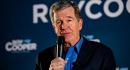
Democrat Roy Cooper flips North Carolina's U.S. Senate seat held by GOP since 2015
ASHEVILLE - A decade of control over North Carolina's coveted U.S. Senate seat ended after a campaign plagued by gaffes, scandals and self-inflicted wounds. Former Democratic Gov. Roy Cooper defeated Republican Michael Whatley in North Carolina's closely watched U.S. Senate race Nov. 3, flipping a seat held by Republicans since 2015 and delivering one of the nation's most consequential Democratic victories as Democrats battle for control of the U.S. Senate. Cooper's win means North Carolina will send a Democrat to the Senate for the first time since Kay Hagan, who lost her reelection bid to Republican Thom Tillis in 2014. Tillis announced his retirement in 2025 after breaking with President Donald Trump over major budget legislation. The victory also gives Democrats a critical pickup in their effort to overturn the Republicans' 53-47 Senate majority, a task requiring a net gain of four seats. Cooper, who served two terms as governor after 16 years as attorney general, entered the contest with formidable name recognition and a history of statewide victories. His campaign emphasized affordability, health care costs and his record of expanding Medicaid coverage to more than 700,000 North Carolinians. Whatley, a former state and national Republican Party chairman making his first run for elected office, entered with Trump's endorsement, considerable fundraising support and an extensive network of national Republican connections. None of it was enough. By October, Cooper's perceived lead had become so substantial that national Republicans began redirecting advertising resources elsewhere. The Senate Leadership Fund, a major Republican political action committee, abandoned planned spending in North Carolina to concentrate on more competitive contests, including Kansas. An Oct. 1-7 SurveyUSA poll showed Cooper leading 54% to 40%. An Oct. 18-20 Carolina Journal poll placed Cooper ahead by roughly 10 percentage points. Whatley nevertheless pressed forward with appearances alongside Trump and Vice President JD Vance, framing Cooper as soft on crime while defending the administration's economic record despite voters' persistent concerns about rising prices. Whatley's campaign plagued by missteps Whatley's campaign was beset by a collection of self-inflicted controversies, some serious, others merely embarrassing, that repeatedly distracted from his message. In June, his campaign posted artificially generated images celebrating the Carolina Hurricanes' Stanley Cup appearance. The images featured players who did not actually exist on the team. When reporters subsequently asked Whatley to name his favorite Hurricanes players, he struggled to identify even one. The awkward episode became an unexpected symbol of another problem his attempts to establish himself as an authentic North Carolinian. Whatley repeatedly described growing up in Blowing Rock, but an NBC News investigation revealed he was born in Lansing, Michigan, and spent most of his childhood there, moving to North Carolina partway through high school. A far more consequential controversy erupted over his support for Harvey West Jr., a convicted child sex offender who held positions within the North Carolina Republican Party. West confirmed Whatley appointed him to the party's influential Plan of Organization Committee in 2021 and 2024, raising questions about Whatley's judgment and leadership. The revelations were particularly damaging given Whatley's repeated attempts to portray Cooper as dangerously lenient toward criminals. His campaign also leaned heavily on questionable claims about public safety, including an allegation that Cooper bore direct responsibility for the 2025 Charlotte murder of Ukrainian refugee Iryna Zarutska. PolitiFact rejected that assertion. Whatley repeated another demonstrably false claim in October, insisting Cooper had been attending a climate event in New York when Tropical Storm Helene devastated Western North Carolina in September 2024. Cooper had returned to North Carolina two days before the storm struck and was directing emergency preparations and response efforts from Raleigh. Helene recovery record draws scrutiny Perhaps Whatley's most damaging vulnerability in Western North Carolina was his own performance in a role bestowed upon him by Trump. In January 2025, Trump designated Whatley to help oversee Helene recovery, charging him with ensuring the rebuilding effort went well. Whatley later served on the FEMA Review Council, which issued reform recommendations more than five months behind schedule. A September Asheville Citizen Times investigation revealed that public records documented just six text messages and five telephone calls totaling 38 minutes between Whatley and Sharon Decker, a senior state recovery adviser, over approximately one year. Broader searches found no direct communications with senior federal emergency management officials, relevant state agencies or the 12 counties surveyed. The searches could not account for undocumented conversations or in-person meetings. Records showed Decker repeatedly sought assistance with stalled funding, special economic development incentives and federal decisions affecting storm-damaged communities. Whatley promised to help with a proposal modeled on post-Katrina Gulf Opportunity Zones, but the records showed no written follow-up for nearly five months. Decker also supplied information demonstrating that existing Opportunity Zone boundaries excluded Canton's former paper mill property, a major redevelopment opportunity. A separate Citizen Times investigation found Whatley had helped prepare FEMA recommendations that could move flood insurance toward private companies while he and his family held between $36,008 and $190,000 in investments tied to that industry . The holdings raised potential conflict-of-interest questions, although they did not establish improper conduct. His campaign did not directly answer questions about the investments, instead saying Whatley supported requiring elected officials to divest individual stocks or place them in blind trusts. Republicans could not reverse Cooper's momentum Whatley's difficulties unfolded against increasingly unfavorable national political conditions for Republicans, including economic anxiety, higher energy costs and dissatisfaction with Trump's administration. Cooper capitalized by presenting himself as an experienced executive focused on household finances rather than the partisan confrontations dominating Washington. Whatley's experience running party organizations and working in national politics proved insufficient against a candidate who had already won six statewide elections. In the end, Trump's personal endorsement, outside spending and visits from nationally prominent Republicans could not reverse the momentum. As of 8:30 p.m. and with 71 of 2,626 precincts reporting, Cooper was ahead by a margin of 66.4% to 32%, per the North Carolina State Board of Elections. Results remain unofficial until certified by the NCSBE on Friday, Nov. 13. More: Trump's approval rating in October in NC poll marks 'worst on record' More: Haywood GOP officials bar Citizen Times reporter from Whatley event Cory Vaillancourt is the Helene Recovery/Investigations Reporter for the Asheville Citizen Times. Find him on X at @The_CoryV or on Signal, via email at cvaillancourt@citizentimes.com or at 912-508-5640. This article originally appeared on Asheville Citizen Times: Democrat Roy Cooper flips North Carolina's U.S. Senate seat This article originally appeared on Asheville Citizen-Times at https://www.citizen-times.com/story/news/politics/elections/2026/11/03/nc-senate-race-cooper-whatley-election-results/92219035007/