SENSEX
NIFTY
GOLD
USD/INR

Weather

image 19    C

World News

Yahoo

World / Yahoo

details

Democrat Abdul El-Sayed wins historic Senate race in Michigan

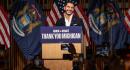
Former Wayne County and Detroit health director Abdul El-Sayed, a child of Egyptian immigrants who ran on a progressive platform and has withstood an unprecedented level of attack ads against him and a campaign where he was unfairly described as a jihadist and sympathizer to terrorism, made history Nov. 4 by winning Michigan's open U.S. Senate seat. Decision Desk HQ and Fox News called the race for El-Sayed by 2 a.m. Wednesday, Nov. 4. He will become the nation's first Muslim U.S. senator when the next Congress takes office in January, having defeated Republican former U.S. Rep. Mike Rogers in a hard-fought race that saw incredible levels of outside spending and in-state intrigue right up to Election Day. El-Sayed, 42, of Ann Arbor, replaces Democratic U.S. Sen. Gary Peters who is stepping down after two six-year terms. With 70% of the vote tallied, El-Sayed led Rogers 52%-46% and hadn't trailed in the count all night. Rogers, a former FBI agent and staunch conservative making his second attempt in two years to win an open U.S. Senate seat in Michigan, was trying to overcome historical trends, political headwinds and the polls to become the first Republican to win a Senate seat in the state in 32 years. El-Sayed will join a new Democratic majority in the U.S. Senate, that party having already been projected to flip Republican-held seats in Iowa, Kansas, Maine, North Carolina, Ohio, South Carolina and Texas. Michigan had been widely looked at as Republicans' best chance of flipping a Democratic-held seat. Democrats, riding a wave nationwide, also took control of the U.S. House headed into President Donald Trump's final two years in office. You took a chance on the unlikeliest of candidates. This is all yours. Michigan, I cannot wait to serve you, El Sayed said in a speech to supporters in which he declared victory at about 1:30 a.m. Wednesday, Nov. 4. Thank your for your trust, and your belief and your kindness. Michigan, we did it, he said. On Election Day, El-Sayed was greeted like a rockstar as he stopped at a polling place at his alma mater, the University of Michigan, being swarmed by students as he posed for photos on a day when the turnout of younger voters was expected to be a big factor in the outcome. Several students who met El-Sayed were moved to tears. A DJ played Michigans fight song as the crowd swelled outside a campus voting hub on South State Street. Pre-med students Anokhi Changra and Chloe Slawson, said they voted for the Democrat because they share his views on health care, the environment and abortion rights. Hes just very morally and politically aligned with me, Changra said. A conservative heckler who shouted at El-Sayed to denounce an Iranian military force or any Islamic terrorist organization was booed. But the Democrat's support stretched well beyond Ann Arbor. Leaving Livonias Webster Elementary School polling location about 1 p.m. Angela Fletcher-Cook, 47, of Livonia, said she was appalled by abuse directed at him during the campaign. I think hes going to be great for Michigan, that he really cares about us and wants the best, she said. Breanna Wynn, a 27-year-old Detroiter, dropped off her ballot on election morning at the Northwest Activities Center in northwest Detroit, saying she was most excited to vote for El-Sayed as the candidate who she felt would fight most strongly against the Trump administrations attempts to dismantle democracy, but added that all her votes up and down the ballot mattered to her greatly. If you didnt vote in the midterms, you didnt vote, she said. Rogers without question had enormous support as well. West Bloomfield resident Tammy Shammaz, 61, voted at her polling place at Covenant Baptist Church in the township shortly before noon. A longtime Republican, she said she was enthusiastically supporting Rogers as well as Republican U.S. Rep. John James in the governor's race. We need to bring manufacturing back to this country we live in the Motor City, she said. I remember back in the day we had hundreds of small companies, small factories. That is gone and we need to bring that back here. And I believe that John James and Mike Rogers will facilitate that. Shortly before 9 a.m. Sahar Haddad, 64, of Dearborn said shes voted for Democrats previously in her life but now votes Republican. She voted for Rogers at Dearborns Lowrey Middle School. Hes been in politics a long time, so hes got experience, she said. Hard-fought, ugly and expensive The campaign for Peters' seat was expensive, ugly and hard-fought from the start. At the end, it was rocked by the unprecedented decision of U.S. Rep. Haley Stevens, a centrist Democrat who had lost the nomination to El-Sayed in August but voiced support for him after the primary, to endorse Rogers the Sunday before the election , arguing that El-Sayed hadn't addressed the concerns of Jewish Democrats and had rejected her help. Excoriated for making the switch, Stevens, a four-term congresswoman who had previously criticized Rogers as a rubber stamp for President Donald Trump's agenda, was criticized by all corners of her party, her political career likely effectively over. Republicans praised her, and Trump invited her to join the GOP, but it was unclear what effect if any her much-publicized switch made since absentee and early voting had been underway for weeks. But that was merely the last shot fired in a battle unlike any seen for a U.S. Senate seat and perhaps any statewide seat in Michigan. According to Open Secrets, which tracks political spending, more than $300 million in spending by groups outside Michigan and independent of the campaigns flooded the airwaves with ads in the state, and the candidates raised more than $100 million combined. Those numbers were preliminary and were expected to grow. While Rogers, who served in Congress from 2001-2015 and is a former House Intelligence Committee chair who had been an occasional critic of Trump's before adopting his agenda and winning his endorsement in 2024 and this year, largely had the Republican nomination to himself, the Democrats had a fractious three-way fight to decide the nomination. Ahead of the August primary, state Sen. Mallory McMorrow, D-Royal Oak, dropped out of the race, confronted by more than $30 million which pro-Israel groups, including organizations linked with the American-Israel Public Affairs Committee, or AIPAC , spent on behalf of Stevens, a staunch defender of Israel who after the primary got engaged to a lawyer and prominent Jewish Democrat, Jason Turkish. AIPAC's main target, and Stevens', was El-Sayed, however. El-Sayed, a harsh critic of Israel and its treatment of Palestinians, called for a halt to military aid to that country and was criticized for campaigning with Internet streamer Hasan Piker, who in turn had been chastised for previous anti-Israel comments some Jews called antisemitic (which Piker denied). But he clearly benefited from a growing movement in the Democratic Party that questioned aid to Israel and the Netanyahu government's counteroffensive against Hamas in Gaza. El-Sayed himself was called antisemitic by some, but he routinely and consistently denounced antisemitism and political violence of any kind, while arguing that Israel is engaged in genocide and that military spending abroad would be better spent inside the United States on access to health care, education and other priorities. But El-Sayed had more than that going for him. A Michigan native who attended the University of Michigan and trained as a medical doctor but turned to public health rather than practicing medicine, El-Sayed is a progressive firebrand, and a powerful orator, engaging his audiences with infectious rhetoric and an easy-to-remember message that he never wavered from: Money out of politics, money in your pocket, Medicare for All. With supporters including U.S. Sen. Bernie Sanders of Vermont, U.S. Rep. Alexandria Ocasio-Cortez of New York and the UAW, he beat Stevens in the Democratic primary by a narrow margin , despite being favored in the polls by a much larger one. But the stage was set and Rogers and his allies set about defining El-Sayed more directly as a radical who was out of step with Michigan voters and values, sympathetic to terrorist groups and a socialist. For his part, El-Sayed attempted to remain on message, he and his allies running dozens of ads and the Democratic nominee repeatedly arguing that the election was not about his name or his ethnicity but the cost of fuel pushed to record highs by Trump's war with Iran, a tariff war with Canada that was uniquely hurting Michigan businesses, access to health care and the need to get corporate money out of politics. I've been consistent, El-Sayed said on Sunday, Nov. 1, as the Stevens endorsement of Rogers broke. I want to get money out of politics. I want to put money back in pockets. I want Medicare for all. I want to take on the heinous price of gas, the ridiculous price of groceries, the fact that people in the richest, most powerful country in the world cannot see a doctor. The notion that we should continue to breathe, unclean air or unclean water. That has been the focus of this campaign since April of 2025, when we kicked it off. Claims of antisemitism and Islamophobia hung over the race But the concerns of some Jewish voters remained a central theme of the campaign. One group of rabbis and other Jewish leaders called on El-Sayed to not only denounce antisemitism, which he had already done, but also voice support for Israel's self-sovereignty in the Middle East , which he did not given his earlier arguments that Palestinians deserve to be safe and receive humanitarian treatment in their own homes as well, and that the Netanyahu government had denied them that. El-Sayed also declined to denounce Piker, while decrying several of his more incendiary and controversial remarks. He was criticized for not more strongly denouncing ads like one, not put out by his campaign but aired briefly by a supportive group, that linked the price of groceries to U.S. support for Israel in Gaza and elsewhere. El-Sayed noted it was not his ad and he did not agree with its content, however. Significantly, El-Sayed did during one debate with Rogers refuse to say whether he considered Iran or Israel more of a threat to the United States, calling the question a ridiculous hypothetical. It remained an open question whether Jewish Democrats would vote against him en masse, perhaps defecting to Rogers, as some including Stevens' fiance indicated they would. Rogers courted that vote, as well as the vote of Black Detroiters after Stevens won the primary in that city while losing statewide, claiming throughout that he was making inroads. More than that, however, Rogers and his allies ran an aggressive campaign of attempting to denigrate El-Sayed's character, including attempts to link him with the Muslim Brotherhood, though he had never been part of that organization and denounced it on the campaign trail absolutely. Misleading claims trying to link El-Sayed with groups that some of his and his wife's family members had been involved with that were in turn mentioned as being connected with potential terrorist groups were made by Rogers and his campaign as well, despite the fact that there was no evidence El-Sayed himself was directly associated with those groups or that he or his wife's relatives were in any way connected with wrongdoing or terrorism. In some cases, the campaign became far uglier than that, as Trump himself began calling El-Sayed Mohammed as an apparent slur and U.S. Sen. Ted Cruz, R-Texas, called him a jihadist who would try to institute Islamic religious law, despite a lack of any evidence supporting either claim. Cruz even said that American lives could be at stake if El-Sayed were given a senator's security clearance to sensitive information, in what appeared to be a blatantly prejudiced remark given he has made no similar accusation we're aware of to a non-Muslim candidate. In a state with a large Arab-American and Muslim community such a strategy was risky. Rogers repeatedly said himself that he wasn't questioning El-Sayed's faith or ethnic background but his connections and sympathies. And in some cases, those questions seemed warranted, especially by Jewish Democrats and their allies who were incensed when, in remarks he later retracted, El-Sayed said hurt people, hurt people in response to an attack on Temple Israel in West Bloomfield. (El-Sayed later acknowledged it was the wrong thing to say.) He was repeatedly asked to denounce Piker's remarks, and did so, such as when Piker compared El-Sayed's workers knocking on doors for support in West Bloomfield to a Black civil rights activist looking for support among Ku Klux Klan households, though he never denounced Piker specifically. His biggest funders are from a group that supports the Muslim Brotherhood. He gets money from people who support openly Hamas, Hezbollah, Al Qaeda, Rogers said at one point in a debate at WOOD-TV in Grand Rapids in early October so fractious that moderator Rick Albin said he had never seen anything like it. Rogers went on to ask for support from anyone willing to stop a guy who can't condemn terrorism in our own country because he's so close to the people who are supporting the Muslim Brotherhood. But even when El-Sayed did denounce the group, Republicans as he predicted would not let it go. Rogers had high obstacles to overcome But Rogers had his own obstacles to contend with, and they weren't minor ones. Despite having lost a narrow election for an open U.S. Senate seat in 2024 to then-U.S. Rep. Elissa Slotkin, Rogers was facing not only the historical fact that the party in power in this case the Republicans tends to lose seats in midterm elections like this one, but also high fuel prices caused by the Iran war, a much-maligned tariff war with Canada waged by Trump and the president's poor job approval ratings. Some Republicans, like former FOX News host Tucker Carlson, maligned Rogers as being a product of the deep state, and spoke in defense of some of El-Sayed's statements. Rogers made a late attempt to break with Trump on the war, saying on Sept. 21 that it needed to end quickly, because of the effect it was having on increased prices, and, on Trump's tariff war with Canada in early October . Given that he had defended both, and continued to argue justifications for them afterward, his position was criticized by Democrats as equivocal and flipflopping for reasons of political expediency, not an actual breaking with Trump. Meanwhile, establishment Democrats, from Gov. Gretchen Whitmer and others who had endorsed Stevens, coalesced behind El-Sayed. Senate Democratic Leader Chuck Schumer, who El-Sayed has said he'd like to see replaced, endorsed him. Former President Barack Obama campaigned with him in Detroit on Oct. 24, saying: Whenever a movement builds to challenge that broken system, the people who benefit from the status quo will say and do anything to stop that train from coming, he said. They will use lies and they will use fear, and they will use division, and they may even use your name or your faith to somehow suggest that you are dangerous and less than trustworthy, and less patriotic and less American then they are. We have seen this movie before. I starred in it. I've got a long form birth certificate to prove it. This stuff didn't work on me, not in Michigan. It's not going to work on Abdul, Obama said. The following day, on Oct. 25, Trump campaigned for Rogers and other Republicans in Port Huron, defending the war in Iran and again repeating false claims about El-Sayed. In the last few weeks, polls, which had been within the margin of error, appeared to showed the Democratic nominee expanding his lead, though it still appeared the election could be up for grabs. By Nov. 3, the RealClearPolling.com average of polls showed El-Sayed ahead 5.3-percentage points and, more than that, a series of recent polls had shown him building bigger and bigger leads on Rogers. The Republican, meanwhile, claimed that the early vote model his campaign put together showed him 7 points ahead of El-Sayed, suggesting he could win if the model was correct and his supporters turned out on Election Day. It never materialized. They turned this race into a simple choice, El-Sayed said. They want an America that's too small for some us. We know America is big enough for all of us. Contact Todd Spangler: tspangler@freepress.com . Follow him on Twitter @tsspangler. Staff writers Beki San Martin, Keith Matheny, Darcie Moran, Dana Afana, Dave Boucher and Violet Ikonomova contributed to this story. This article originally appeared on Detroit Free Press: El-Sayed claims victory, wins historic U.S. Senate race This article originally appeared on Detroit Free Press at https://www.freep.com/story/news/politics/elections/2026/11/04/el-sayed-rogers-who-won-michigan-senate-race/92501377007/

4 Nov 2026 12:35 pm