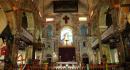
Santa Cruz Basilica: The 'Sistine Chapel' of Fort Kochi
David Lawrence does not consider himself the ideal Christian. Yet every morning, he slips quietly into the Santa Cruz Basilica in Fort Kochi his parish church and spends thirty unhurried minutes there. This is how I begin my day. This is my ritual, my anchor - and has been for many years now. It is essential. To quieten the mind, to reflect, to lift my thoughts, he says. This reverence, David adds, is stirred in part by the intricate frescoes that stretch across the churchs ceiling. They are luminous and deepen my sense of devotion. Indeed. Step into the Basilica and your gaze is immediately drawn skyward, to the long nave, where the ceiling frescoes unfold like a series of story panels, each scene guiding the eye onward, until it rests at the main altar at the far end. I have been to Rome to see the Sistine Chapel. Many famous murals adorn that chapel. Yet, I feel the ones here at Santa Cruz are no less magical, no less stirring, he adds. The altar of Santa Cruz Basilica Though unfamiliar with the finer points of the art world, Davids nod to the Sistine Chapel is fitting. The frescoes at Santa Cruz Basilica were done by an Italian Jesuit brother and painter named Antonio Moscheni, along with his disciple De Gama, says Rakhi Mariam Johnson, an architect and researcher who has done extensive studies on church architecture of Kerala. Accounts on Antonio reveal that the artist had spent his youth in Rome, studying the masterpieces in the Vatican. Apparently, it is there that he developed an interest in fresco painting. Several of his works can be found in the churches of Italys Bergamo province, and, as his talent attracted attention, in places as far as Croatia and Albania. In 1898, Antonio was assigned work in India to paint the chapel of St Aloysius College in Mangaluru, which was then recently founded by Italian Jesuits, reads a note shared by the college. Over the course of two years, Antonio covered walls, ceiling and pillars with framed, vivid tableaux on the life of St Aloysius Gonzaga, the colleges patron saint, and on the mysteries of the Christian faith. Because paints were not available locally and Europe was too far, Antonio prepared the paints using vegetable dyes, the note further reads. The frescoes that adorn the chapel of St Aloysius College in Mangaluru Though Antonio was to return to Europe after completing the college work, his fame had by then spread in India, and requests came from all quarters for similar works. The chapel of the Kankanady Hospital (Father Muller Hospital), the Mangaluru seminary, the Church of Most Holy Saviour in Bantwal (Karnataka), and the Cathedral of the Holy Name in Bombay (Mumbai) were some of the immediate beneficiaries. Then, in 1905, came the request from the then-bishop of Cochin for work on the newly constructed cathedral in Fort Kochi. Now, as equally enchanting as Antonios masterpiece in Mangaluru was the storied history of the Cochin cathedral, rendering it impossible for an artist then to overlook a chance to work here. The cathedral was built on the site where a church had stood for centuries, says Rakhi. The original church, built in 1505 during the Portuguese period, was repurposed into an arms storehouse when the Dutch had foothold in Cochin, and was later destroyed when the British took over in 1806. The frescoes that adorn the chapel of St Aloysius College in Mangaluru The present cathedrals construction, she says, began in 1887 and was completed in 1905, a period when the Neo-Gothic style was popular worldwide. The Indo-Gothic architecture twin towers, pointed arches, ribbed vaults and decorative elements must have been a departure from the Kerala-style, Baroque-influenced facades common in Kerala then, she observes. Therefore, Santa Cruz Basilica is one of the rare churches in Kerala, Rakhi adds. Add to this amalgamation the mastery of Antonios artworks, and what you have is indeed a wonder. Sadly, it is not adequately preserved, the parishioners point out. The frescoes that adorn Santa Cruz Basilica in Fort Kochi And no one feels the pain more profoundly than young Lynell de Rozario, whose brother describes her as deeply religious. I have been part of Santa Cruz Basilica my entire life. I have seen the gradual deterioration of the murals and ceiling paintings up close, says Lynell, even amidst a flurry of work tending to the upcoming consecration of a new bishop in Fort Kochi after 25 years. What used to be vibrant and full of detail is now faded, with visible moisture damage and fragile patches that can no longer be ignored. Agnes* (name changed), another parishioner, feels the same. They have done some restorations. But it has come at the cost of these works not looking like historic paintings anymore. They likely painted on top of the original, she says. Unsound and unscientific restoration work taken on the instigation of those who are clearly not experts in the field has been the bane of built heritage in Kerala, points out Biley Menon, co-convenor of the local chapter of the Indian National Trust for Art and Cultural Heritage (INTACH). David concurs. Recently, he and several others had to step in to dissuade a move to redo the cathedrals altar. Finally, it was paused so as not to create needless disturbances during the tourism season. As you know, scores of tourists come to see this church, which has a huge historical and cultural significance, he says. Santa Cruz Basilica; A self-portrait of Antonio Moscheni One of the likely reasons why the frescoes here have remained largely intact for this long despite being so close to the sea and the erratic restoration attempts lies in a secret technique employed by Antonio, reveals Nilabh Sinha, the principal director of INTACH New Delhi and an expert on murals. Apparently, there are two types of fresco work: buono (true fresco) and secco. Secco is the method most commonly used in India. It involved applying dry plaster to the wall and then painting on it with pigments, says Nilabh. Antonios works were done in the true fresco or buono style. The other place you see this kind of work is the Sistine Chapel. Here, the artist prepares a lime-based plaster and paints on it while its still wet. The pigment fuses into the plaster as it dries, forming a permanent bond. Over time, carbonation occurs, creating a protective film over the painting, Nilabh says. This, he adds, ensures the painting remains intact unless the plaster or wall itself is damaged. Antonios work in Mangalurus St Aloysius College was done in the buono method, and given that the Kochi cathedral was also done by him, it is safe to assume that it is a similar method. However, to be sure and a conservation treatment to be designed, a technical study has to be made, Nilabh concludes. The silhouette of Santa Cruz Basilica This is also what a section of the parishioners suggests: regular checks and a complete scientific study. After all, these are not just paintings. They are part of Kochis heritage and cultural landscape, points out a church member. A careful, well-guided restoration, he insists, is essential. Antonio was a man of God. His paintings not only draw the admiration of all who see them, but also raise their hearts and minds to God, says an official of the chapel at St Aloysius College. For Antonio, who now rests in an unmarked grave somewhere in Kochi (sadly, he died four days before the consecration of the church in 1905), what better tribute than to see his final work restored to their due glory. Perhaps when Monsignor Antony Kattiparambil takes charge as the 36th bishop of the Roman Catholic Diocese of Cochin on December 7, could his first set of orders also include this?

 20 C
20 C