Weaving a millennium-old journey
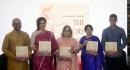
Express News Service Some histories survive not in stone inscriptions or textbooks, but in language spoken at home, recipes passed down from kitchens, and clothes woven over generations. For a community that migrated over a thousand years without losing its name, language or craft, documentation becomes an act of preservation. The book From Homeland to Heartland: The Story of the Sourashtras , unveiled on Sunday at THE Park is both record and remembrance of the past. Authored by Anitha Rajarajan and Biswajit Balasubramanian, the coffee-table book brings together migration, textiles, faith, food, and lived memory into a single, accessible narrative. The launch was conceived as a multisensory experience, extending the books themes beyond the page. Guests were welcomed with a thoughtfully curated Saurashtrian menu that traced the communitys long journey across regions. From Debili of Gujarat and Kothi Vadi from Maharashtra to Punugulu recalling the Vijayanagar era, the culinary trail culminated in Tamil Nadu with idli and Saurashtra amti, before closing with bun halwa, a sweet symbol of memory and identity. The launch happened in the presence of scholars, writers, cultural practitioners and members of the Sourashtra community, with Nirmala Lakshman, as chief guest, Preetha Reddy, vice-chairperson of Apollo Hospitals Group, as guest of honour, and author and historian Sriram V as special guest. Opening the event, Biswajit Balasubramanian spoke about how a single question what their ancestors names might have been a thousand years ago sparked years of research and travel. He noted that much of the communitys recorded history existed only in Tamil. We needed a book in English, not a heavy research document, but something engaging, visual and easy to read, something a young Saurashtrian in Chennai or Singapore or Berlin could pick up, he said. He concluded by saying, Our migration has three striking pillars: our language, our mastery of textiles, and royal patronage.This is not the final word on Sourashtras. It is the beginning of a larger conversation. Anitha Rajarajan traced the communitys deep-rooted presence in Madurai, describing the city as the cultural headquarters of the Sourashtras. The Sourashtras have always lived with a quiet sense of purpose never loud, never demanding, yet deeply woven into the citys progress, she said. From pioneering education initiatives and early noon-meal schemes to contributions in textiles, music, cinema, and philanthropy, she outlined how the community became quietly woven into Madurais civic and cultural life, emphasising the need to document lived histories. Commending the authors, Sriram spoke about the importance of communities recording their own narratives, because, when history is written only through an external lens, it becomes authoritative and everything else is considered inferior. While Preetha reflected on food, fabric, and ritual as living archives of civilisation, Nirmala described the book as a meticulous and much-needed documentation. She shared, Saurashtrans came not just as settlers, but engaged deeply with local society and contributed to Tamil civilisational life. She added that the book reminds how migrant communities have shaped Tamil Nadu, while retaining their own distinct identity. Designed with photographs, illustrations, maps, QR codes, and oral histories, From Homeland to Heartland stands as both a cultural archive and an invitation for future generations to read, remember, and continue.

 18 C
18 C