The legacy of Dikshitar & his music
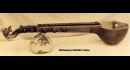
Imagine a young man, a formidable scholar already steeped in Sanskrit, philosophy, logic, and music, standing conflicted by the waters of the sacred Ganga. This young man was none other than Muthuswamy Dikshitar. He had journeyed to Kasi with his guru, Chidambaranatha Yogi a spiritual master who arrived at Dikshitars house to take him under his tutelage, fulfilling the prophecy: When the student is ready, the master arrives. Standing on the Hanuman ghat, Muthuswamys mind was a battleground. Should he follow his illustrious lineage, a family famed for serving courts and crafting temples, or answer a deeper call: to become a travelling singer of Gods praise, echoing the voices of the ancient Bhakti saints? Iconography and musical signature The answer came not as a pronouncement, but as a divine, silent object. Advised by his guru to bathe, Dikshitar was met by a veena floating towards him from the river. This singular moment separates his story from the other great Trinities of Carnatic music. The Veena became his iconic shadow, a visible sign that his path would be one of profound, internal surrender, uniting knowledge and devotion. Returning from Kasi, with veena in hand, the young composer stopped at Thiruttani, a quiet mountain shrine dedicated to Lord Muruga. It was here that the narrative leaps into the realm of dhyana (meditative practice) and its fruit, yoga. As shared by V Vishnuramprasad, a strategic marketing consultant by profession, and a subject matter expert of Diskhitar, who is not only initiated in the oral tradition but deeply immersed in it as well. Dikshitar placed the veena at Murugas feet and began his pradakshina (circumambulation). An old man called out, affectionately feeding him kalkandu (sugar candies), and instructed him to sing the Lords praise. When Dikshitar turned back, the man was gone. In that instant a moment of pure, sweetened enlightenment Dikshitar received his mantra and his signature: Guru-Guha (The one whose home is the cave of sacred light). What followed was the spontaneity of an elevated mind singing Sri nathadi guru guho jayati jayati, his first composition in Mayamalavagowla ragam. This legend carrying the sweetness of transformation and divine intervention is not just biographical fluff. It is the very heart of sampradaya (oral practice). It signifies that the masters knowledge is not merely transferred through books, but is heard, absorbed, relished and lived through sudden, profound shifts within consciousness. The veena symbolises the vehicle of his rarified knowledge, and the candy, the essence of bhakti. Vishnuramprasad The ancestral blueprint To understand the weight of his choice, we must look to the ancestry he chose to step away from, yet whose genius he inherited. As Vishnu notes, The family were temple builders and codifiers. His lineage traces back to Govinda Dikshitar, a Kannada Brahmin who was a driving force behind the physical expanse of the Tamil Nadu temples, including the vast corridors of Rameswaram and the perimeter of Thiruvanaikaval. His son, Venkatamakhin, penned the Chaturdandiprakashika, a treatise that codified Carnatic music and remains as the foundation even today. So to put things in perspective, Dikshitars choice to shift the ancestral blueprint from stone and court to sound and oral memory requires notice. His decision to continue in the lineage of the Alvars and Nayanmars, who moved from temple to temple, recording the sthala puranam (temple history), the land, the people, and the presiding deities in song conveys a shift that hides a critical truth. Not only does it reveal how values are appropriated and prioritised over furthering a familys material legacy, but it also exposes how the binding identity of Bharatiya that has one foot in socio-political and another in socio-economic angle is in fact tied at the top at a central point to the cultural outlook, wherein the sentiment of bhakti could blur many lines. Besides the obvious, the profound knowledge system of Dikshitar is visible in every one of his works. Take, for instance, the legend behind his Navagraha kritis. When his disciple Sudhamadhala Thampiappan suffered unbearable pain due to the affliction of Shani (Saturn), Dikshitar did not resort to ritual; rather, he used music to heal him. He composed divakara tanujam (in Yadhukula Kambhoji) to relieve the pain. This moment of using raga and tala to shift planetary influence also sparked Dikshitar to compose kritis for all other grahas. In his iconography, the presence of astrological charts alongside the veena is thus a deliberate cypher. It tells the connoisseur that his compositions are not just about music; They hide Chakra, Tantra, Jyotisha, and Mantra a knowledge system encrypted within the melodic structures. Thiruttani Gods Integrity of oral practice Today, celebrating Dikshitar 250 years later, the article is less about the legends mentioned and more about the preservation of his artistry and the milestones of his spiritual sojourns. In recording the specific details of the temples, deities, and local customs in his songs, Dikshitar created a colossal socio-cultural memory bank. His kritis are invaluable to cultural anthropology, providing an authentic, internal view of the social fabric of his time. This is where the relevance of some oral practitioners becomes starkly contemporary. We are witnessing a cultural moment where this cherished fabric is under pressure. New interpretations, often driven by foreign ideas and personal agendas, seem to dilute or politicise the Carnatic traditions. A true seeker or connoisseur will therefore need to learn to judge the craft of those, looking beyond fame gained through awards and social media noise, recognising that innovations outside the traditional framework are but fleeting. Such a rasika will begin to honour the tradition (sampradaya sangitam) that is eternal by recognising those whose integrity and loyalty appear simple, perhaps even old-fashioned, but who possess the depth of having experienced knowledge. Thus, the legacy of Muthuswamy Dikshitar is not just 250 years of musical compositions that are beautiful. It is a lesson that tradition is not about knowing, but living it; not diluting it, but growing it; passing it on and keeping it burning as the knowledge that propels our civilisational ideas and cultural vibrancy. And so, within the framework of Carnatic tradition, the continued existence of people like Vishnu, who effortlessly share their depth of lived experiences of knowledge without the need for reference or preparation, is the enduring proof that Guru-Guhas spirit still resonates. As rasikas, to experience something truly surreal like the Guru-Guha spirit of Carnatic music, efforts must go in to finding those within text, tradition and practice the ones who embody the modesty and simplicity of the sampradaya, for in their passion, traditions pulsate; in their silence, cultural values resonate. Also, if the appreciation of Dikshitars works in present times is undertaken with an approach to discriminating knowledge from craft, then a seed containing the hallmark of the Indic worldview will get sown that will someday reap more Vishnus. Recommended books about Muthuswamy Dikshitar Muthuswamy Dikshitar by TL Venkatrama Aiyar Sri Muttusvami Diksitar, A journey through his life and musi c by Dr V Raghavan

 18 C
18 C