Every country has a city that travellers underrate for the crime of being pleasant, and in Morocco that city is Rabat. The capital lacks Marrakech’s theatre and Fes’s labyrinth, and the guidebooks reward it with a dutiful half-day between trains. What the hurried miss is that Rabat is the most liveable, most orderly, and most quietly beautiful of Morocco’s imperial cities, blue-and-white lanes above a river mouth, Roman ruins where storks nest on minarets, an Atlantic corniche the locals actually use, and, crucially for the independent traveller, the easiest driving in the entire kingdom. If Morocco by car has an ideal training ground, this is it.
The market makes the experiment cheap. The listings of cars in Rabat run from around 200 to 350 dirhams per day for city cars and economy models, with compact SUVs from roughly 400 dirhams and family and executive tiers above, this being a capital of ministries and embassies with the fleet to match. Pickup covers Rabat-Salé airport, the Rabat Ville and Agdal train stations, and hotel delivery across the city, one-way arrangements toward Casablanca, Fes, or Tangier open the longer itineraries, and the comparison happens before the flight: verified suppliers on one screen via OneClickDrive with real photos and transparent pricing, an assisted booking where the team confirms the car and the all-important gearbox for your dates, a small advance of around ten percent to secure it, and the balance settled directly with the supplier at handover.
What follows is the case for giving the capital real time, and the roads that radiate from it.
The Capital at Walking and Driving Pace
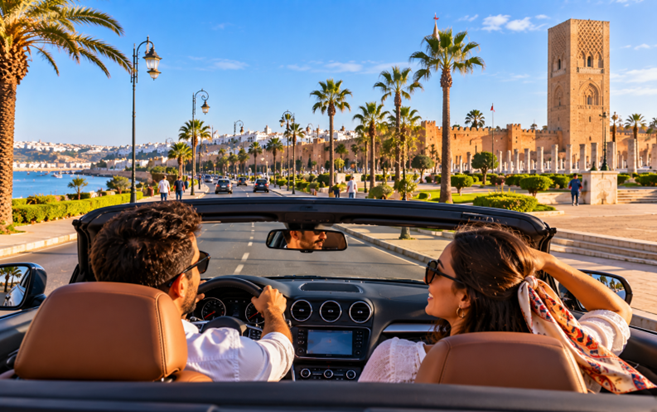
Rabat splits neatly into a walking core and a driving ring, and the trick is knowing which is which. The walking core is world class: the Kasbah of the Udayas, all blue-washed lanes and Andalusian gardens perched over the Bou Regreg estuary, flows downhill into a medina that trades at local prices with none of the tourist-city hustle, and the ensemble of the Hassan Tower and the Mohammed V Mausoleum, the unfinished great minaret beside the gleaming royal tomb, sits an easy stroll east. Park at the edges, as the capital’s drivers do, and give this core an unhurried day.
The driving ring is where the car starts paying. The Chellah, the most atmospheric ruin in urban Morocco, a walled Roman-then-Merinid necropolis colonised by nesting storks, sits a short drive from the centre; the Atlantic corniche runs south past surf clubs and lighthouse viewpoints toward the beaches of Harhoura and Skhirat; and across the river, Salé’s own medina and the boat-builders along the bank offer the capital’s mirror image with barely a tourist in sight. Rabat traffic, by Moroccan standards, is almost sedate, lanes respected, roundabouts polite, trams gliding through on their own rails, which is exactly why first-time Morocco drivers should consider starting their trip here rather than in Casablanca’s assertive scrum. The national customs still apply and still charm: coins for the blue zones and the vested parking guardians, posted speeds respected because radar is routine, documents ready for the occasional friendly checkpoint, and the medina entered on foot, always.
Day Trips in Every Direction
Geography is Rabat’s quiet superpower, sitting on the autoroute spine with half the country within a comfortable radius. South, Casablanca and the Hassan II Mosque are barely an hour away, close enough that many travellers now sleep in calm Rabat and visit the big city, rather than the reverse. North, the coast road reaches the lagoon of Moulay Bousselham in about ninety minutes, flamingos, fishing boats, and grilled sardines, one of the Atlantic coast’s best-kept secrets. East, the autoroute puts Meknes and the Roman mosaics of Volubilis around two hours out and Fes within two and a half, which converts the most intimidating imperial city into a day trip with an escape route. Even Tangier and the blue north sit two and a half easy hours up the toll road. No other Moroccan base offers this spread on roads this good, and every kilometre of it is smooth, signed, modestly tolled tarmac well inside a standard agreement.
The booking craft carries over unchanged from everywhere in the kingdom: declare the automatic need at reservation because manual is the national default, confirm the insurance excess by name, match the mileage terms to the day-trip ambitions above, and film the slow handover walkaround, panels, wheels, spare, and triangle, keeping the video until the keys go back. Paperwork stays light, a home licence held a year, an International Driving Permit recommended, passport, and a deposit card, with minimum ages generally from 21.
The Other End of the Kingdom
There is a second, far less told Morocco that the same booking model unlocks, and it sits at the opposite corner of the map. The Oriental region around the eastern capital rarely makes first itineraries, which is precisely its appeal: arranging car hire in Oujda opens a landscape most visitors never learn exists, the blue-flag beaches of Saidia, the so-called blue pearl of the Mediterranean, fifty minutes north, the green folds and gorges of the Beni Snassen mountains with the Zegzel valley’s orchards threading through them, and a city whose Andalusian-flavoured medina and music traditions run on entirely local rhythms. Oujda’s airport receives direct flights from across Europe, serving the great diaspora summer return, and the rental economics mirror the national pattern, economy cars from around 200 dirhams per day, booked through the same assisted model with the same small advance and the same supplier handover at the airport. For second-visit Morocco travellers, or first-timers allergic to crowds, the east is the kingdom’s quietest reward, and the car is not optional there; it is the entire infrastructure.
Between the two cities, the two Moroccos, the polished Atlantic capital and the unhurried Mediterranean east, the lesson is the same one this country teaches everywhere: the train line shows you Morocco’s cities, but only the road shows you Morocco. Rabat makes the gentlest possible introduction to that road, storks over the Chellah at golden hour, the corniche at sunset, Fes and Casablanca both a morning away, and the keys cost less per day than dinner for two in the Kasbah’s garden café. Give the capital its two or three days, point the bonnet wherever the map whispers, and let the most underrated city in the kingdom do what it does best, which is send you off calm, confident, and already planning the eastern trip.
Image by https://www.oneclickdrive.ma/