India has made strong progress in getting children into schools, but learning outcomes still tell a different story. Many students move to higher classes without fully understanding basic concepts. In this blog, we will look at where these gaps come from and how AI and NEP 2020 are helping address them.
What Are the Learning Gaps in India’s Education System
A learning gap is the difference between what a student is expected to know and what they actually understand. It builds over time. When basic concepts are missed early, it becomes harder for students to keep up in higher classes.
In India, these gaps are quite visible, especially at the primary level. According to the ASER 2024 report, only around one in four Class 3 students can read a Class 2 level text. When it comes to basic math, the situation is similar. Only about 30 percent of Class 5 students are able to solve simple division problems.
This shows a clear gap between literacy and numeracy skills among young learners. Students are moving to higher grades, but their foundational understanding is not always strong.
At a broader level, India’s literacy rate stands close to 80.9 percent, but this number does not tell the full story. There are still noticeable differences across regions and between boys and girls. Access to quality education is not equal everywhere, which adds to the problem.
How AI and NEP 2020 Are Bridging the Learning Gap in India
India is not ignoring this challenge. National Education Policy 2020 and AI-based tools are both trying to improve how students learn and how teachers teach.
1. Focus on Foundational Learning
NEP 2020 puts strong attention on early literacy and numeracy. The idea is simple. If a child gets reading and basic maths right in the early years, everything else becomes easier to learn later.
Schools are now encouraged to strengthen these core skills at the primary level instead of rushing through the syllabus.
2. Shift From Rote Learning to Conceptual Understanding
For a long time, learning in many classrooms has been focused on memorising answers. NEP 2020 is trying to change that.
It promotes critical thinking and competency-based learning. Students are expected to understand concepts instead of repeating them. This helps them apply what they learn in real situations, not just exams.
3. Personalised Learning Through AI
Not every student learns at the same speed. Some need more time. Others move faster.
AI-based platforms adjust content based on how a student is performing. If a student is struggling, the system offers simpler explanations or extra practice. If they are doing well, it moves them ahead. This creates a more balanced learning experience.
4. Adaptive Assessments and Real-Time Feedback
Traditional tests often come too late to fix problems. By the time results are out, the student has already moved on.
AI changes this by identifying learning gaps instantly. Students get feedback right after attempting questions. This helps them correct mistakes early and improve steadily.
5. Teacher Support and Efficiency
Teachers handle large classrooms, which makes individual attention difficult.
AI tools provide insights into student performance. They highlight who is struggling and in which area. This reduces manual checking and planning time, allowing teachers to focus more on actual teaching.
6. Scalable Learning Solutions
Digital platforms can reach students across cities, towns, and villages. This makes quality learning resources available beyond metro areas.
For Tier 2, Tier 3, and rural regions, this is especially useful where access to experienced teachers or learning material may be limited.
7. Improved Accessibility and Inclusivity
India has multiple languages, and that often becomes a barrier in learning.
With NEP encouraging multilingual education, AI tools are now offering content in different regional languages. This helps students understand concepts better in the language they are comfortable with.
8. Data-Driven Decision Making
AI systems track how students perform over time. This data helps teachers and schools understand patterns.
Instead of guessing where students are struggling, decisions can now be based on actual performance data. This improves both teaching methods and student outcomes.
How Extramarks Is Bridging Learning Gaps With AI-Powered Features
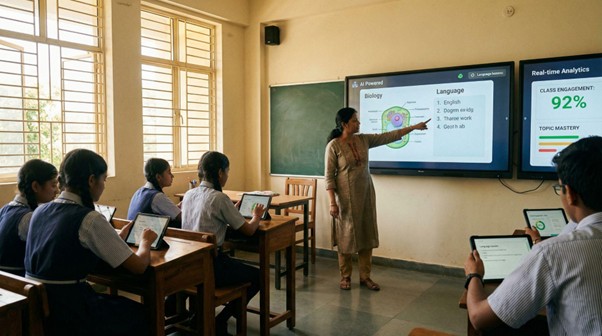
Extramarks is using AI in a way that directly supports both students and teachers inside the classroom.
1. Personalised Lesson Planning and Content Creation
Teachers often spend a lot of time preparing lessons. Extramarks extra intelligence simplifies this by generating curriculum-aligned lesson plans and teaching material instantly. This helps maintain consistency and ensures that students are learning in a structured way.
2. Multilingual Learning Support
The platform allows lessons to be converted into different regional languages. This makes it easier for students from diverse backgrounds to understand what is being taught without feeling left out.
3. AI-Powered Assessments and Instant Evaluation
Extramarks can evaluate student answers quickly, including handwritten responses. Teachers get immediate insights, and students receive timely feedback. This helps identify learning gaps early instead of waiting for final exams.
4. AI-Powered Doubt Resolution and Guided Problem Solving
Students can ask questions through text, voice, or even images. The system responds with clear explanations and step-by-step guidance. This approach focuses on building understanding rather than just giving answers.
5. Real-Time Engagement and Classroom Insights
The platform tracks student participation and attention levels during lessons. If a student starts falling behind, teachers can step in early. This prevents small gaps from turning into larger problems later.
Closing Thoughts
India has made strong progress in expanding access to education, but improving learning outcomes is the next challenge. NEP 2020 sets the direction, and AI adds the tools needed to follow through.
When used thoughtfully, this combination can help reduce learning gaps and create a system where students not only attend school but actually understand what they are being taught.
Image by https://www.extramarks.com/