
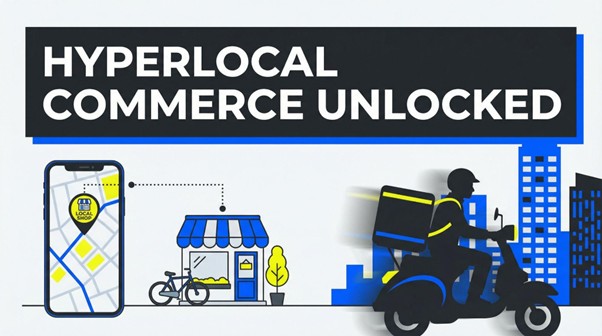
Walk through any local market today and you will notice something changing. Small shops are no longer limited to foot traffic, they are selling online within their own neighbourhoods. This shift is being powered by no code builders that let business owners create websites, apps, and ordering systems without technical skills. In this blog, we will look at how these tools are helping hyperlocal e commerce grow across India and what it means for small businesses.
What Is Hyperlocal E Commerce and Why Is It Rising in India?
Hyperlocal e-commerce focuses on delivering products from nearby sellers to customers within a small geographic area, often within minutes or a few hours. Its rise in India is closely tied to changing consumer habits and faster digital adoption. According to Makreo Research, the market is growing at over 50% annually, largely because people now expect quicker deliveries and smoother service. The push for 10 to 15 minute delivery, along with micro-warehousing, electric delivery fleets, and AI-led logistics, has made this possible. You can already see this shift in most cities, where fast delivery is slowly becoming something people just expect.
How No Code Builders Are Enabling Hyperlocal E Commerce
Behind this rapid growth, there is a layer of technology that often goes unnoticed. No-code builders for hyperlocal ecommerce are one of the biggest reasons why more businesses are able to enter this space. Here’s how they help:
1. Removing Technical Barriers
Earlier, building an e-commerce platform required developers, time, and a lot of money. No-code tools remove that problem. You can create a store, set up products, and start selling without writing a single line of code. This makes it easier for local businesses to go online without depending on technical teams.
2. Faster Time to Market
Speed matters in hyperlocal commerce. If your competitor launches faster in your area, they start capturing demand immediately.
No-code builders help you launch quickly. What used to take weeks can now be done in a few days. This speed gives businesses a chance to test ideas, adjust quickly, and stay relevant in a fast-moving market.
3. Cost-Effective Setup and Operations
Setting up an e-commerce business used to require a massive budget. Development costs, maintenance, and updates added up over time.
With no-code platforms, most of that cost comes down. You pay for the platform and start operating. This makes it more practical for small businesses that want to try hyperlocal delivery without taking big financial risks.
4. Built-In Integrations for Daily Operations
Running a hyperlocal business is not just about selling products. You need payment systems, delivery tracking, inventory updates, and customer communication. No-code builders usually come with these features already built in. This keeps everything connected and reduces manual work.
5. Improved Customer Experience
Customers expect a smooth experience from browsing to checkout. No-code platforms help create clean, easy-to-use storefronts. Features like real-time tracking, instant notifications, and simple checkout flows make the buying process better for customers.
6. Mobile-First Approach for Indian Consumers
Most users in India shop through their phones. No-code builders are designed with this in mind. They create mobile-friendly stores that load quickly and work well even on basic devices. This improves reach and engagement.
How Zopping Enables Hyperlocal E Commerce
Platforms like Zopping are built specifically to support businesses that want to operate locally but think digitally. Instead of stitching together multiple tools, you get everything in one place. Here’s how it helps:
1. No Code Store Builder
Zopping’s no code store builder lets you create and launch your online store without any technical setup. You can add products, set pricing, and customise your store layout using a simple interface.
It is built for speed and control. You can make changes anytime without depending on developers, which helps you get started quickly and keep your store updated as your business grows.
2. Order Management That Keeps Things Moving
Handling orders manually can slow everything down. Zopping brings all your orders into one place so you can track them from start to finish.
You can process multiple orders together, send automatic updates to customers, and stay informed about every step of the delivery. Returns and exchanges are also easier to manage, which helps maintain a better customer experience.
3. Inventory Management Without the Guesswork
Managing stock across products can get messy, especially when demand changes quickly. Zopping helps you organise your catalogue with categories, variants, and tags so everything stays structured.
You can upload products in bulk, track stock levels in real time, and get alerts when items are running low. This reduces the chances of missed orders and keeps your store ready for demand.
4. Delivery Management That Fits Your Model
Delivery is at the centre of hyperlocal commerce. Zopping lets you define your delivery zones clearly and choose how you want to fulfil orders.
You can manage your own fleet or connect with delivery partners. Orders can be prioritised automatically, routes can be planned smarter, and customers receive updates along the way. This keeps operations smooth while improving delivery speed.
Final Thoughts
Hyperlocal e commerce is growing because it matches how people live today. Faster decisions, smaller orders, and a preference for convenience are shaping buying behaviour.
No code builders are making it easier for businesses to keep up with this shift. You do not need a large team or complex systems to get started anymore. With the right tools, even a small local business can build, manage, and scale its own hyperlocal store.
If you are thinking about entering this space, now is a good time to explore it. The demand is already there. The tools are ready. The only thing left is getting started.
Image by https://zopping.com/